GOVERNMENT & NATIONAL SECURITY
Add Movement to the Investigative and Intelligence Picture.
Commercial location intelligence for complex government investigations, operations, and analytical missions.
Reveal helps authorized government investigators and analysts transform commercially available device location data into intelligence about movement, recurring activity, geographic relationships, and patterns relevant to defined mission requirements.
From case-driven investigations to cross-border and strategic analysis, Reveal provides another perspective for understanding where activity occurs, how it develops over time, and where meaningful investigative or intelligence relationships may exist.
Complex Missions Require Context Across Time and Place.
Government investigators and analysts work across records, interviews, intelligence reporting, OSINT, digital evidence, investigative information, partner reporting, and other sources to answer different—but often interconnected—questions.
An investigator may need to develop the next lead in a complex case. An intelligence analyst may need to understand recurring activity across an environment. A protective or operational team may need additional context around activity relevant to a defined mission.
Location intelligence adds movement and geography to each of those perspectives.
Commercial device location data can help authorized users explore historical movement, recurring activity, geographic relationships, and changes in observed patterns—providing another intelligence source for investigative follow-up and broader analytical assessment.
Reveal complements existing investigative and intelligence resources. It provides another perspective to evaluate—not a standalone determination of identity, intent, affiliation, or threat.
From Commercial Data to Investigative & Intelligence Leads.
01 — Begin With the Mission Question
Start with information relevant to an authorized investigation or intelligence requirement—such as a location, time period, device identifier, geographic area, event, or other known context.
02 — Explore Relevant Location Intelligence
Examine commercially available device observations relevant to the investigative or analytical question.
03 — Identify Patterns & Relationships
Explore movement, recurring locations, geographic relationships, changes in observed activity, and other patterns that may warrant additional investigation or analysis.
04 — Develop the Next Lead
Evaluate location intelligence alongside other available information to identify potential investigative leads, inform further analysis, and determine appropriate next steps.a
Mission question → Location intelligence → Investigative or analytical lead → Further assessment
Intelligence for Diverse Government Missions.
Criminal & Administrative Investigations
Add movement and geographic context to complex government investigations involving fraud, theft, misconduct, criminal activity, or other matters within an agency's investigative authority.
Fraud, Waste & Abuse
Support authorized investigations involving suspected misuse of government programs, funds, assets, contracts, or resources by adding location intelligence to existing records and investigative information.
Force, Personnel & Facility Protection
Add location intelligence to protective and investigative efforts involving government personnel, facilities, installations, events, and other mission-relevant environments.
Border & Cross-Border Intelligence
Explore observed movement across borders and jurisdictions to identify patterns, recurring activity, and geographic relationships relevant to authorized investigative and border-security missions.
National Security & Threat Investigations
Add geographic and movement-based context to authorized investigations and analysis involving locations, activity, networks, or other indicators relevant to national-security requirements.
Transnational & Multi-Jurisdictional Activity
Explore movement and geographic relationships across locations, jurisdictions, and countries as part of complex investigations or broader intelligence assessments.
One Intelligence Source. Multiple Mission Perspectives.
INVESTIGATIVE
Develop the Next Lead.
Use location intelligence within case-driven investigations to explore relevant movement, recurring locations, geographic relationships, and other patterns that may provide additional investigative direction.
Complex investigations
Fraud, waste & abuse
Criminal investigations
Internal misconduct
Cross-jurisdictional cases
OPERATIONAL
Understand Activity Around the Mission.
Examine location intelligence relevant to personnel, facilities, events, geographic areas, or other defined mission environments to provide additional situational and protective context.
Personnel & force protection
Facility security
Relevant events
Areas of interest
Cross-border activity
STRATEGIC
Understand Patterns Across the Environment.
Examine broader movement patterns, changes in observed activity, and geographic trends over time to add commercial-data context to strategic intelligence assessments.
Movement trends
Regional dynamics
Changes in activity
Cross-border patterns
Longitudinal analysis
Historical Context
Examine available observations across periods relevant to an investigation or intelligence requirement.
Recurring Activity
Identify locations or geographic patterns appearing repeatedly within available observations.
Movement Analysis
Explore how observed device activity develops across locations and time.
Geographic Relationships
Surface shared locations and spatial relationships that may provide investigative leads or warrant further assessment.
Cross-Jurisdictional Context
Examine observed movement extending across cities, states, regions, countries, or other jurisdictional boundaries.
Follow Activity Across Time and Geography.
Patterns in commercial location data are investigative and intelligence indicators. Their significance depends on mission context, other available information, data characteristics, and appropriate professional assessment.
Government investigations and intelligence missions rarely depend on a single source of information.
Another Layer of Investigative & Intelligence Context
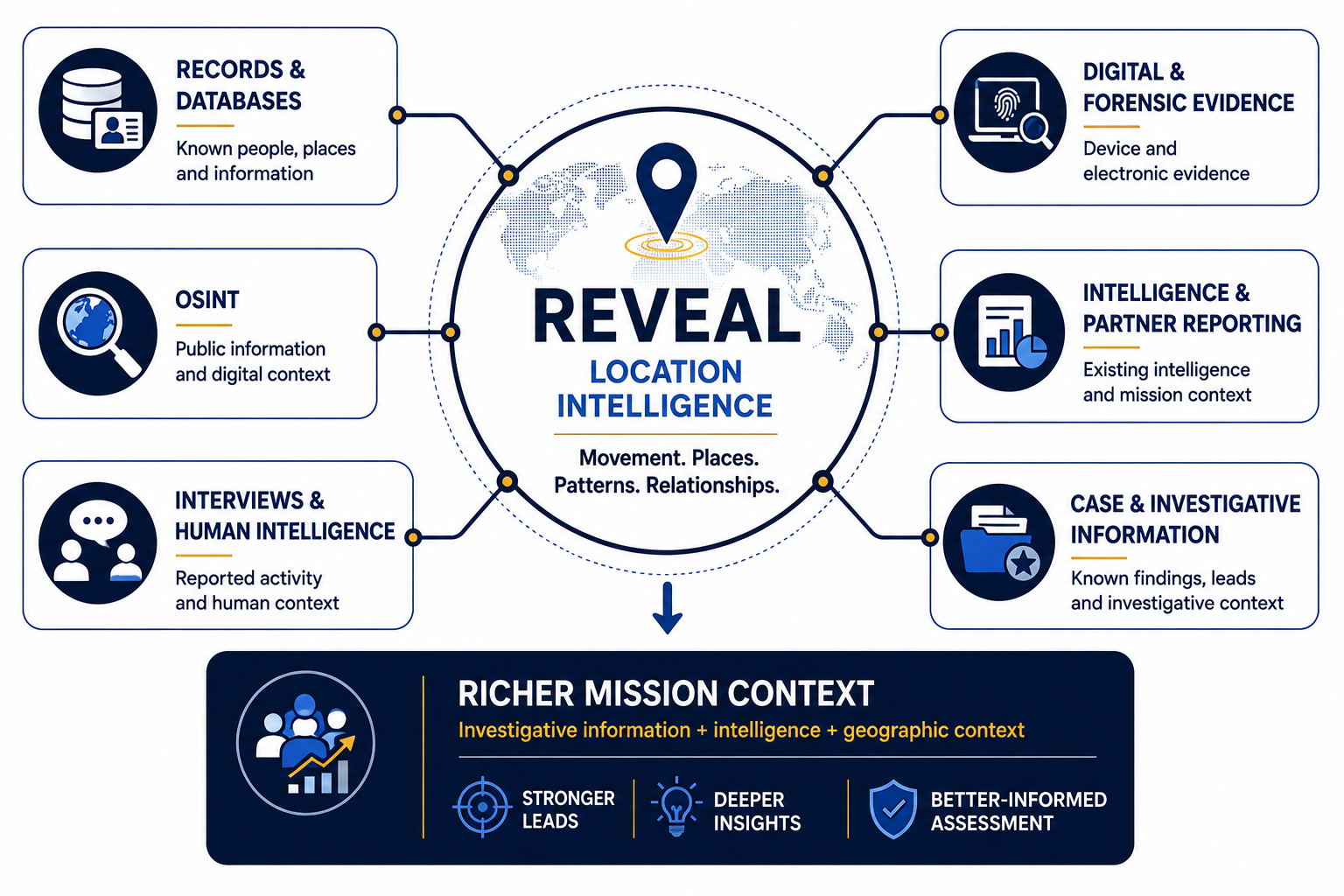
Records and databases establish known information. OSINT provides public and digital context. Interviews and human reporting add observations and perspective. Digital and forensic evidence can reveal additional activity, while existing case information and intelligence reporting provide mission-specific context.
Location intelligence adds movement and geography to that picture. Reveal can help investigators and analysts explore how relevant activity develops across time and place—surfacing patterns, recurring locations, and geographic relationships that may provide a new investigative lead or warrant further analytical assessment.
Used alongside other available information, these insights can help government teams ask better questions, focus investigative resources, and develop a more complete understanding of activity relevant to the mission.
Intelligence Without Borders.
National-security challenges are inherently international. Movement, networks, geopolitical events, transnational activity, and security risks frequently span countries and regions.
Fog provides access to SDK-derived commercial location intelligence spanning 200+ countries and territories, supplemented internationally by low-latency Location Stream coverage across 40+ markets and a trusted network of regional partners.
HISTORICAL LOCATION INTELLIGENCE
200+ Countries & Territories
Analyze commercially available historical observations to examine movement, recurring patterns, locations, and geographic relationships over time.
LOW-LATENCY LOCATION STREAM
40+ International Markets
In supported markets outside the United States, Location Stream provides more current RTB-derived mobility observations for analysis in Reveal. Fog intentionally does not offer Location Stream within the United States as part of its differentiated, privacy-forward data model.
A Location Observation Is a Lead—Not a Conclusion.
A device observation or geographic relationship does not independently establish:
Identity — A device identifier should not automatically be assumed to represent a particular individual.
Presence — A device observation should not automatically be treated as definitive proof of a person's precise physical presence.
Association or Affiliation — Shared locations or recurring geographic relationships do not independently establish a personal, organizational, criminal, or operational relationship.
Intent — Movement or presence alone does not explain why activity occurred.
Wrongdoing or Threat — Observed patterns do not independently establish criminal conduct, misconduct, hostile intent, or national-security significance.
Reveal helps investigators and analysts identify patterns, develop leads, and ask better questions. Findings should be evaluated alongside other available information and appropriate investigative or analytical methods.
Built for Investigative & Intelligence Missions.
Investigators
Develop additional leads and geographic context within criminal, administrative, fraud, misconduct, and other authorized government investigations.
Intelligence Analysts
Explore movement, recurring activity, geographic relationships, and broader patterns across complex intelligence requirements.
Protective & Security Teams
Add commercial location intelligence to broader efforts involving personnel, facilities, events, and other mission-relevant environments.
Multi-Agency & Interagency Teams
Introduce another intelligence source into complex missions involving multiple organizations, jurisdictions, disciplines, or information sources.
Reveal can support qualified investigative organizations across government, including criminal investigative units, Offices of Inspector General, specialized investigative teams, and interagency task forces.
Technology Supported by Expertise.
Location intelligence is most valuable when analysts understand both the information it can provide and its limitations.
Fog combines:
Technology
Browser-based Reveal capabilities for exploring commercially available device location intelligence.
Training
Education designed to help authorized users understand Reveal, commercial location intelligence, analytical capabilities, and appropriate use.
Analytical Expertise
Support from Fog personnel with experience across law enforcement, government, security, and analytical missions.
Global Support
Regional partners who provide local knowledge, implementation support, training, and market expertise for international customers.
Powerful Intelligence. Responsible Use.
Commercial location intelligence can support consequential government missions. Its value depends on responsible sourcing, appropriate access, defined purposes, informed analysis, and compliance with applicable requirements.
Fog provides Reveal within a framework emphasizing responsible data sourcing, authorized access, permissible use, privacy considerations, and market-specific product availability.
Location intelligence is one analytical input. Reveal is designed to provide additional context and develop intelligence—not independently determine identity, affiliation, intent, threat, or other consequential conclusions.
Add Location Intelligence to Your Mission.
Explore how commercially available device location intelligence can complement your organization's existing analytical resources and provide another perspective on movement, geography, and relationships.
Designed for authorized government, national security, defense, intelligence, border-security, and other qualified public-sector organizations.